
R Rotary Brush Edge Rounding Machine
Edge rounding only — nothing you do not need. One rotary brush group rounds the outer contours and hole edges of laser-cut, punched and sheared parts to a consistent radius in a single pass, so parts come out safe to handle and ready for coating.
- One rotary brush group — pure edge rounding
- 800–1,600 mm working widths
- For laser-cut, punched and sheared parts
- Uniform edge radius in one pass
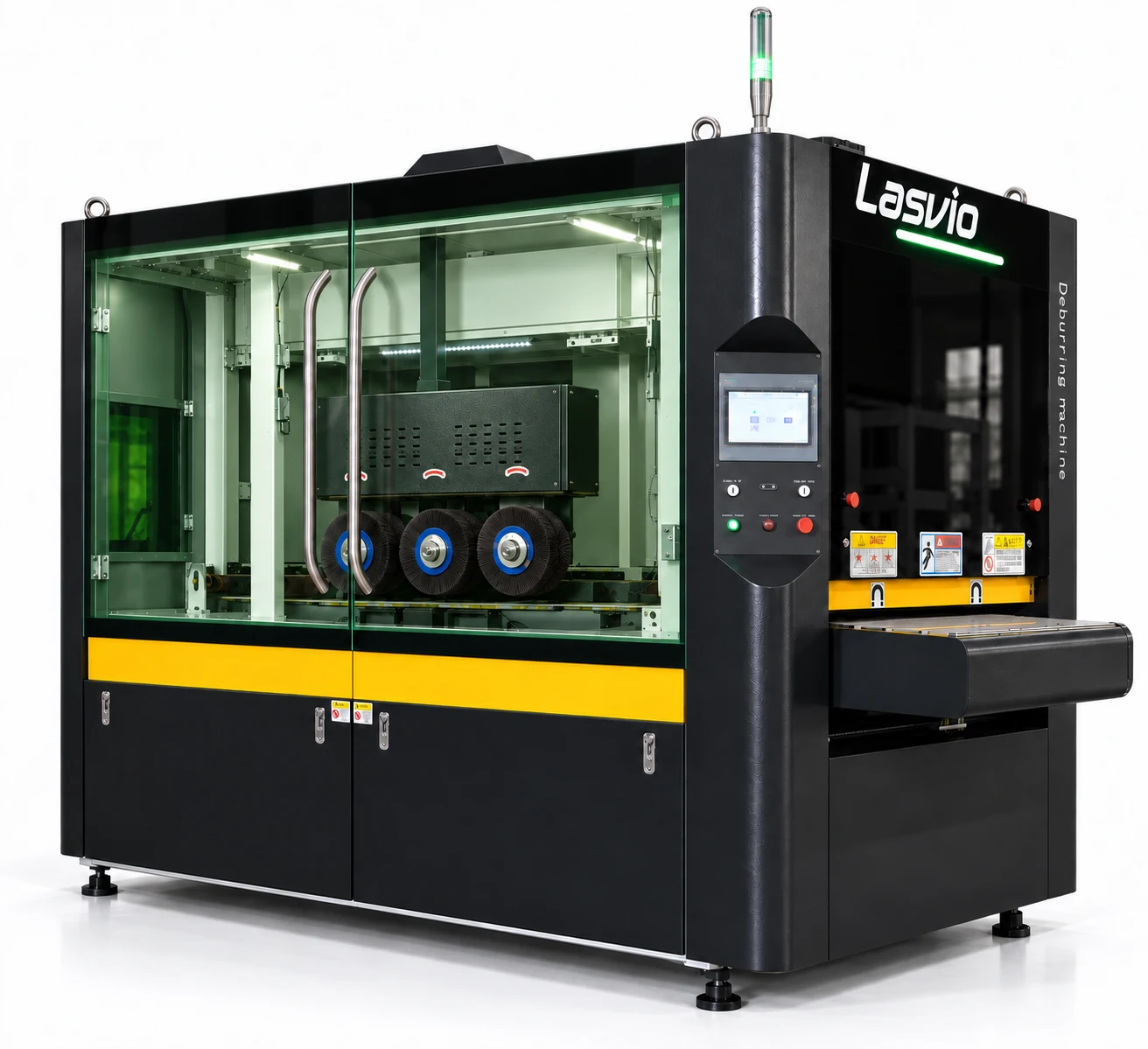
R Quick Facts
Configuration: One rotary brush group
Working Widths: 800 / 1,000 / 1,300 / 1,600 mm
Best For: Laser-cut, punched and sheared parts that need a uniform edge radius — and nothing else
Hold-Down: Magnetic (carbon steel) / vacuum (stainless steel, aluminium)
One-Pass Result: A uniform radius on contours and holes, at full feed speed
Edge Rounding Only — Deliberately
The R exists for a common, specific situation: your parts come off the laser, punch or shear already clean, and the only thing standing between them and the next process is a sharp edge. Sharp edges cut hands, chip coatings and fail safety checks. The R removes exactly that problem — a rotary brush group works over every contour and hole edge and leaves a uniform radius, at full feed speed, with no deburring station in the line and no process you are paying for but not using.
If your parts carry real burrs, they need an abrasive belt before any brush work — see the BR family. If the burrs are heavier or the plate thicker and you need a fuller radius, step up to the RR. And if the parts carry slag from plasma or flame cutting, start with the slag removal configurations instead.
Inside the R: One Brush Group, Every Edge
Station 1 · Rotary Brush Group
Three wide counter-rotating drums reach every contour and hole edge, inside and out. Because the brushes work from multiple directions as the part feeds through, no edge is missed and the radius stays uniform across the whole part.
Hold-down for every material: a magnetic table holds carbon steel; a vacuum table holds stainless steel and aluminium flat — small parts run safely at full feed speed.
Consistent Edge Rounding. No Blind Spots.
Every Contour, Every Hole
Multi-directional rotary brushes reach external contours and internal hole edges alike — the edges a single-direction process leaves sharp.
The Same Radius on Every Part
A fixed brush process does not tire or vary like manual edge work, so the first part and the thousandth come out with the same radius.
Safe to Handle, Ready to Coat
Rounded edges stop handling injuries and give coatings a surface they can wrap and hold — no chipped edges, no rust starting at the rim.
The Finish: A Uniform Radius in One Pass

A uniform radius on contours and holes, in one pass at full feed speed.
R Is the Right Choice When…
- Your laser-cut, punched or sheared parts are already burr-free and only the edges are sharp
- Parts must be safe to handle without gloves-and-care warnings
- Edges chip your coating or fail a customer’s safety inspection
- You want one dedicated, fast rounding pass — not a combination machine
Choose Another Configuration When…
- Heavier burrs or thicker plate need a fuller radius, faster: choose RR
- Parts need deburring AND edge rounding in one machine: see the BR, HBR, BBR and BRB configurations
- Parts carry slag or heavy dross from thermal cutting: see the slag removal configurations
- Edges are fine but the surface needs finishing: see the Complete Finishing configurations
Compare the Edge Rounding Configurations
| Configuration | R | RR |
|---|---|---|
| Configuration | One rotary brush group | Two rotary brush groups |
| Main Result | Uniform edge radius on burr-free parts | Fuller, more consistent radius on heavier burrs and thicker plate |
| Choose It When | Parts are already burr-free and need standard edge rounding | Burrs are heavier, plate is thicker, or throughput matters |
Compare all edge rounding configurations
R Technical Specifications
| Configuration | R — one rotary brush group |
| Working Widths | 800 / 1,000 / 1,300 / 1,600 mm |
| Main Process | Edge rounding & light burr removal |
| Typical Parts | Laser-cut, punched and sheared sheet metal parts |
| Processing Thickness | 0.5–80 mm |
| Feeding Speed | 1–5 m/min |
| Roller Brush Speed | 9–24 r/s |
| Revolving Speed | 9–24 r/s |
| Hold-Down | Magnetic table (carbon steel) / vacuum table (stainless steel, aluminium) |
| Power Supply | 380 V AC, 50/60 Hz (customizable) |
| Air Pressure Required | 0.5–0.8 MPa |
| Service | CE Certified · Global Service |
All listed safety, servo-control, electrical and auto-compensation features are standard equipment.
R Rotary Brush Edge Rounding Machine — Frequently Asked Questions
What does the Lasvio R do?
The R is an edge-rounding-only machine. Its rotary brush group rounds the outer contours and hole edges of laser-cut, punched and sheared parts to a uniform radius in one pass, so parts are safe to handle and ready for coating.
Does the R remove burrs?
Only light burrs, as part of the rounding pass. The R is built for parts that are already essentially burr-free; parts with a real burr load need an abrasive belt station first — see the BR, HBR, BBR and BRB deburring and edge rounding configurations.
How is the R different from the RR?
The R runs one rotary brush group; the RR runs two in sequence — the first breaks the edge, the second completes the radius. Choose the RR for heavier burrs, thicker plate, a fuller radius or higher throughput.
Which materials can the R process?
Carbon steel is held on the magnetic table; stainless steel and aluminium are held flat on the vacuum table. Both hold-down systems keep small parts secure at full feed speed.
How do I confirm whether R fits my parts?
Send the material, thickness, part size and cutting process — or arrange a sample test on your actual parts. If your edges only need rounding, the R is the simplest configuration in the range that does it.
Send Your Parts for an R Test
Sharp edges slowing down handling, coating or inspection? Send us the part details — or your actual parts — and we will run them through the R and show you the radius. If you need the RR‘s second brush group or a deburring configuration instead, we will tell you.