
BR Belt & Rotary Brush Deburring Machine
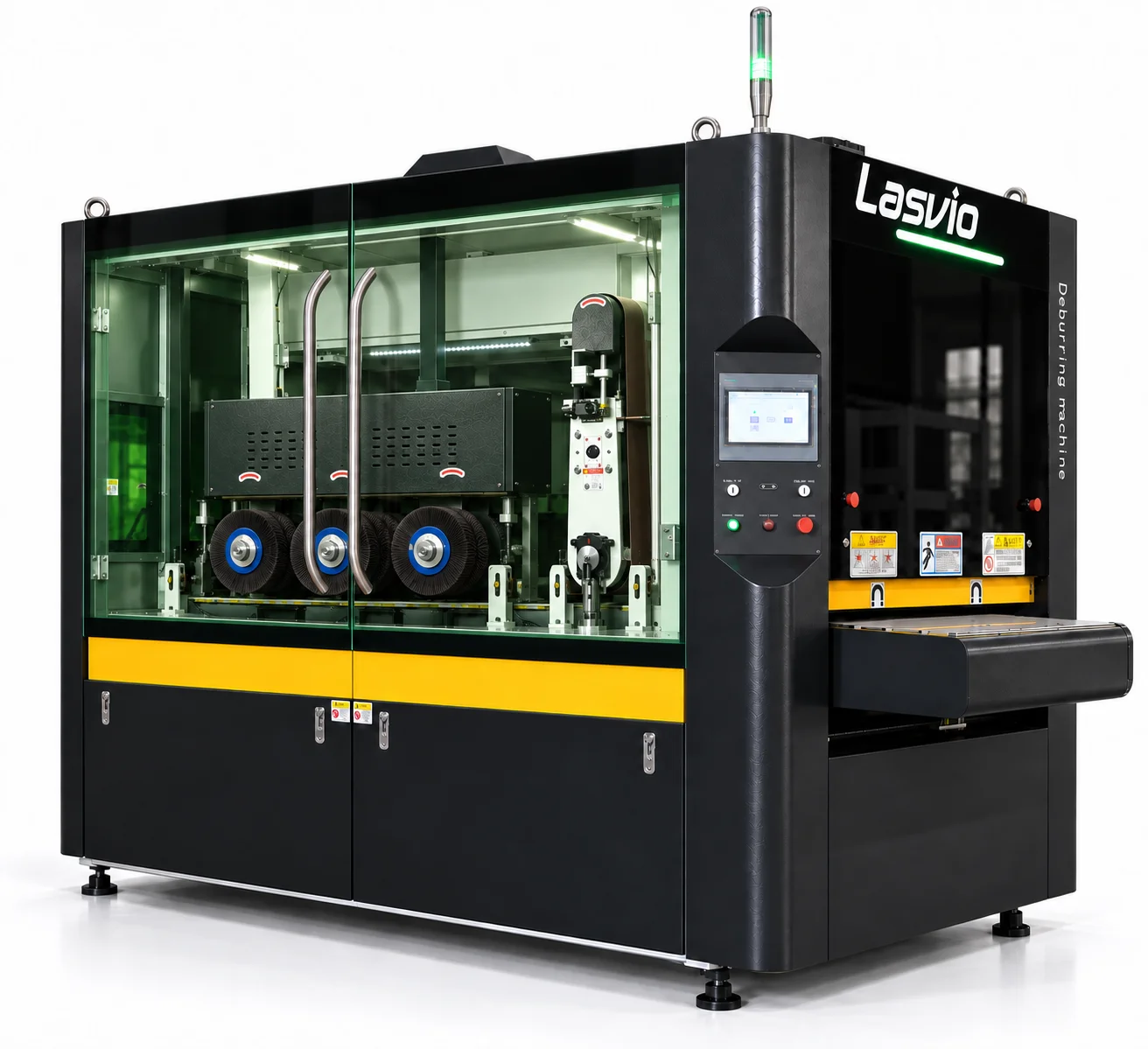
The all-rounder for laser-cut parts: the abrasive belt takes the burrs off and levels the surface, then the rotary brush group rounds every edge — the two jobs every laser-cut part needs, finished in a single pass.
- Abrasive belt + rotary brush group
- 800–1,600 mm working widths
- Deburring and edge rounding in one pass
- Magnetic or vacuum hold-down for every material
BR Quick Facts
Configuration: Abrasive belt + rotary brush group
Working Widths: 800 / 1,000 / 1,300 / 1,600 mm
Best For: Laser-cut parts that need deburring and edge rounding in one machine
Hold-Down: Magnetic (carbon steel) / vacuum (stainless steel, aluminium)
One-Pass Result: Burr-free parts with a uniform edge radius — ready to coat or assemble
Two Jobs Every Laser-Cut Part Needs
Laser cutting leaves two problems on every part: burrs along the cut edge, and corners too sharp to handle, coat or assemble safely. Finishing both by hand is slow and inconsistent — and it is where production queues form. The BR clears both in one pass: the abrasive belt strips the burrs and levels the surface, then the rotary brush group rounds outer contours and hole edges uniformly — no separate deburring step, no hand finishing afterwards.
If your parts come off the laser already burr-free and only need rounding, the R and RR edge rounding configurations are the simpler machines. If the burr load is heavier than one belt can handle, look at the BBR in this family. For slag and dross from plasma or flame cutting, start with the slag removal configurations.
Inside the BR: Belt First, Brushes Second
Station 1 · Abrasive Belt
Removes burrs and levels the surface — including the oxide skin laser cutting leaves behind — so parts reach the brushes clean and flat.
Station 2 · Rotary Brush Group
Rounds outer contours and hole edges uniformly, working every edge the same way — the finish hand grinding cannot repeat part after part.
Hold-down for every material: a magnetic table holds carbon steel; a vacuum table holds stainless steel and aluminium flat — small parts run safely at full feed speed.
One Pass, Both Jobs Done
One Machine, Not Two Steps
Deburring and edge rounding usually mean two machines or a machine plus hand work. The BR combines them in a single pass, so parts leave the line finished instead of queueing twice.
The Same Finish on Every Part
A belt and brush group do not get tired or vary from part to part. Edges come out consistent across a shift — including on nitrogen-cut parts, whose small, hard burrs the belt is well suited to remove.
Ready for Coating and Assembly
Burr-free surfaces and rounded edges are what powder coating and assembly lines ask for — no sharp edges to cut hands, chip coatings or stop a fit.
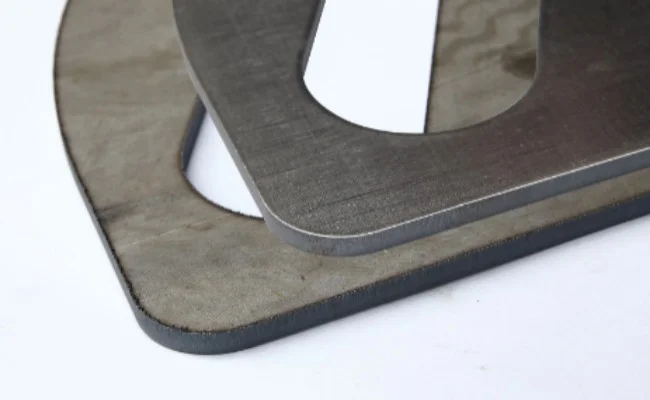
One Pass: Burrs Off, Edges Rounded
The raw laser-cut part below; the BR-finished part on top — burrs removed, surface levelled, corners rounded.
BR Is the Right Choice When…
- Laser-cut parts need deburring AND edge rounding, not just one of the two
- Hand finishing is the bottleneck at the end of your cutting line
- You run a mix of carbon steel, stainless steel and aluminium parts
- Nitrogen-cut parts carry small, hard burrs that still need a clean, rounded finish
Choose Another Configuration When…
- Parts are burr-free and only need edge rounding: choose the R or RR
- Burrs are heavier than one belt can handle: see the BBR in the Deburring & Edge Rounding configurations
- Parts carry slag or heavy dross from thermal cutting: see the slag removal configurations
- The surface itself needs finishing or thickness calibration: see the Complete Finishing configurations
Compare the Deburring & Edge Rounding Configurations
| Configuration | BR | HBR | BBR | BRB |
|---|---|---|---|---|
| Configuration | Belt + rotary brush | Hammer + belt + rotary brush | Two belts + rotary brush | Belt + rotary brush + belt |
| Main Result | Deburring and edge rounding for laser-cut parts | Slag removal with deburring and edge rounding | Heavier burrs with full edge rounding | Edge rounding with a cleaner, mark-free surface |
| Choose It When | Most laser-cut parts — the all-round configuration | Parts carry slag as well as burrs | The burr load is heavier than one belt can handle | Surface quality matters most, on cosmetic parts |
Compare all deburring & edge rounding configurations
BR Technical Specifications
| Configuration | BR — abrasive belt + rotary brush group |
| Working Widths | 800 / 1,000 / 1,300 / 1,600 mm |
| Main Process | Deburring and edge rounding |
| Typical Parts | Laser-cut, thermal-cut, punched and sheared sheet metal parts |
| Processing Thickness | 0.5–80 mm |
| Feeding Speed | 1–5 m/min |
| Roller Brush Speed | 9–24 r/s |
| Revolving Speed | 9–24 r/s |
| Hold-Down | Magnetic table (carbon steel) / vacuum table (stainless steel, aluminium) |
| Power Supply | 380 V AC, 50/60 Hz (customizable) |
| Air Pressure Required | 0.5–0.8 MPa |
| Service | CE Certified · Global Service |
All listed safety, servo-control, electrical and auto-compensation features are standard equipment.
BR Belt & Rotary Brush Deburring Machine — Frequently Asked Questions
What does the Lasvio BR do?
The BR deburrs and edge-rounds laser-cut parts in one pass. The abrasive belt removes burrs and levels the surface; the rotary brush group then rounds outer contours and hole edges uniformly. Parts come off the conveyor burr-free with a consistent edge radius, ready for coating or assembly.
How is the BR different from the R and RR?
The R and RR only round edges — they suit parts that are already burr-free. The BR adds an abrasive belt ahead of the brush group, so it removes the burrs first and then rounds. If your parts need both jobs, the BR does them in one machine and one pass.
Can the BR handle nitrogen-cut parts?
Yes. Nitrogen cutting leaves small, hard burrs and a clean, oxide-free edge; the belt removes those burrs and the brush group rounds the edge. For nitrogen-cut cosmetic parts where a surface freer of fine random marks matters most, see the BRB configuration.
Does the BR work on stainless steel and aluminium?
Yes. Stainless steel and aluminium parts are held flat on the vacuum table while carbon steel runs on the magnetic table, and the belt-and-brush sequence finishes all three materials in the same single pass.
How do I confirm whether BR fits my parts?
Send the material, thickness, part size and the finish you need — or arrange a sample test on your actual parts. If your parts only need rounding, we will point you to the R or RR instead; if the burrs are heavier, we will say so and suggest the BBR.
Send Your Parts for a BR Test
Parts piling up between the laser and the coating line, waiting on hand finishing? Send us the part details — or your actual parts — and we will run them through the BR and show you the finish. If a simpler edge rounding configuration would do the job, we will tell you.
Request a Quote Chat on WhatsApp
← All Deburring & Edge Rounding Configurations Next: HBR — Hammer, Belt & Rotary Brush →