
Deburring is a necessary step in many metal fabrication processes. Whether parts are produced by laser cutting, punching, plasma cutting, or machining, burrs and sharp edges often need to be removed before further processing.
Traditionally, many manufacturers rely on manual grinding to handle this task. However, as production volumes increase and labor costs continue to rise, automatic deburring has become increasingly common in modern fabrication workshops.
So which approach is better?
The answer depends on production requirements, part consistency, labor availability, and quality expectations.
What Is Manual Grinding?
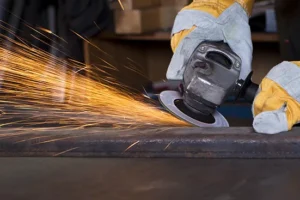
Manual grinding typically involves operators using angle grinders, flap wheels, abrasive tools, or handheld sanding equipment to remove burrs and smooth edges.
This method remains common because it requires relatively low initial investment and can handle a wide variety of part shapes.
Advantages of Manual Grinding
- Low equipment investment
- Flexible for complex or irregular parts
- Suitable for small production batches
- Easy to implement
For workshops processing a limited number of parts each day, manual grinding may still be a practical solution.
Challenges of Manual Grinding
While manual grinding offers flexibility, it also presents several limitations.
Inconsistent Quality
The final result often depends on the operator’s skill and experience.
Different workers may produce different edge conditions on identical parts.
Labor Intensive
Grinding is physically demanding work.
As labor shortages become a growing challenge in many countries, finding and retaining skilled operators can be difficult.
Lower Productivity
Manual grinding can become a bottleneck in production, especially when processing large quantities of laser-cut parts.
The more parts produced, the more labor is required.
Safety Concerns
Handheld grinding tools generate dust, noise, sparks, and vibration.
Long-term exposure may affect operator comfort and workplace safety.
What Is Automatic Deburring?
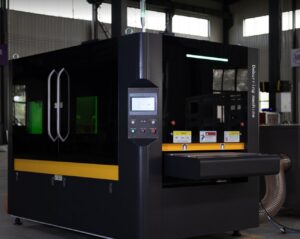
Automatic deburring uses dedicated machines to remove burrs, smooth edges, and improve surface quality in a controlled and repeatable process.
Depending on the machine configuration, automatic systems may also perform:
- Edge rounding
- Slag removal
- Oxide layer removal
- Surface finishing
- Surface brushing
These machines are commonly used in sheet metal fabrication and laser cutting applications.
Advantages of Automatic Deburring
Consistent Results
One of the biggest advantages of automation is repeatability.
Parts can be processed using the same parameters, helping achieve more consistent edge quality across production batches.
Higher Productivity
Automatic deburring machines can process multiple parts continuously, reducing the need for manual handling.
For medium and high-volume production environments, this often results in significant efficiency improvements.
Reduced Labor Dependence
Instead of several operators performing repetitive grinding tasks, one operator can often manage the entire deburring process.
This helps manufacturers address labor shortages and rising labor costs.
Better Preparation for Downstream Processes
Consistent edge quality can improve:
- Powder coating performance
- Welding preparation
- Assembly efficiency
- Product appearance
This is one reason why many manufacturers include deburring as part of their quality control process.
When Does Automatic Deburring Make Sense?
Automatic deburring is often worth considering when:
- Production volumes continue increasing
- Labor costs are rising
- Quality consistency becomes a concern
- Customers require better surface finishing
- Manual grinding creates production bottlenecks
The decision is not always about replacing workers. In many cases, it is about allowing skilled employees to focus on higher-value tasks.
Manual Grinding vs Automatic Deburring: A Quick Comparison
| Factor | Manual Grinding | Automatic Deburring |
|---|---|---|
| Initial Investment | Low | Higher |
| Labor Requirement | High | Low |
| Production Efficiency | Lower | Higher |
| Quality Consistency | Operator Dependent | Highly Consistent |
| Large Batch Production | Limited | Excellent |
| Workplace Safety | More Exposure | Improved |
Final Thoughts
Manual grinding remains a useful solution for certain applications, especially small production runs and complex custom parts.
However, as manufacturers face increasing pressure to improve efficiency, quality, and labor utilization, automatic deburring is becoming an important part of modern metal fabrication.
The choice is not simply about removing burrs. It is about creating a more efficient, consistent, and scalable production process.
For many fabrication shops, the question is no longer whether deburring is necessary, but how to achieve it most effectively.
Need Help Choosing a Deburring Process?
Send us your material, thickness, cutting method, and burr or slag condition. Lasvio can help recommend a suitable deburring, edge rounding, or surface finishing solution for your parts.